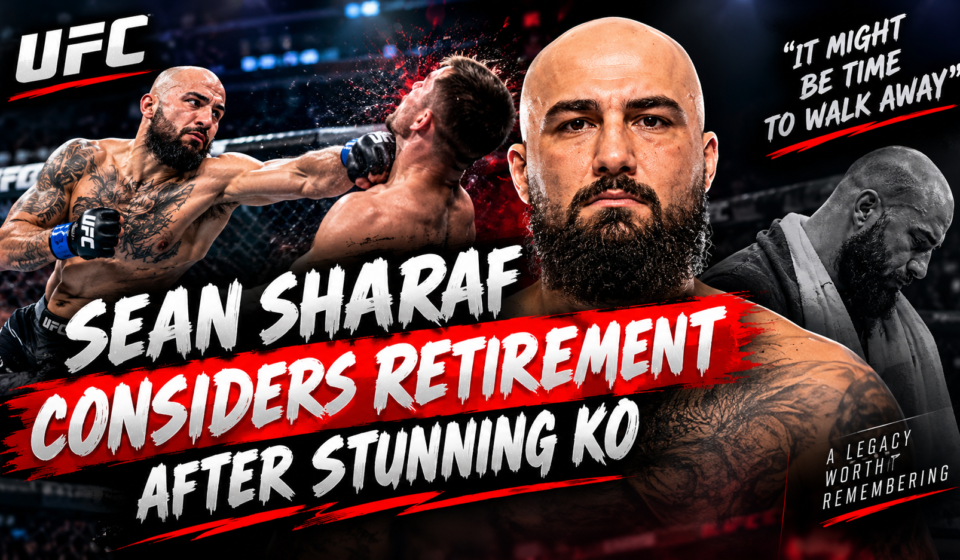
Sean Sharaf Considers Retirement After Stunning KO
Sean Sharaf Considers Retirement After the Biggest Twelve Seconds of His Career
Most fighters spend their whole careers chasing one signature moment. Sean Sharaf got his in less time than it takes to read this sentence, and now he’s wondering if that’s reason enough to walk away.
At UFC 331, Sean Sharaf considers retirement a genuine option after knocking out Olympic gold medalist Gable Steveson in just 12 seconds, a result that instantly became one of the biggest shocks the sport has ever seen. Weeks later, the question still following him everywhere is simple: how do you top a moment like that, and should you even try?
How the Twelve Seconds Happened
Sharaf walked into that cage with a 0-2 UFC record and almost nobody outside his own corner believing he had a real chance. Steveson, a two-time NCAA champion and the headline name of the heavyweight division’s next generation, was supposed to move through him on the way to bigger things. Instead, Sharaf closed the distance immediately, threw a right hand to set up the shot, and followed with a left hook that put Steveson flat on his back before the crowd had even settled into their seats.
It stands as one of the fastest finishes in UFC heavyweight history, and the reaction inside Crypto.com Arena said everything about how unexpected it was. Steveson’s own corner, which included training partner and mentor Jon Jones, could only watch as the hype that had followed him out of wrestling and into the cage evaporated in a single exchange.
Why Sean Sharaf Considers Retirement a Real Option
What makes this story different from a typical feel-good upset is what Sharaf has said since. Speaking candidly, he’s admitted he’s unsure he can ever recreate a moment this big, and that uncertainty alone has him weighing whether to keep fighting at all. It’s a rare kind of honesty in a sport where almost everyone talks about chasing bigger and bigger moments, not wondering if they’ve already peaked.
The backstory makes the question even more understandable. Sharaf has spoken openly about the financial struggle he was dealing with heading into fight night, including being deep in personal debt and without a settled training situation in the lead-up to the biggest fight of his life. Beating Steveson didn’t just change his record, it changed his bank account and his leverage in a sport that rarely hands out second chances to fighters coming off back to back losses.
Even longtime UFC commentator Joe Rogan, usually one of the sport’s biggest advocates for fighters continuing their careers, has acknowledged there’s a legitimate case for Sharaf to walk away now rather than risk chasing a high he may never reach again.
What This Means for Gable Steveson
On the other side of the result, the questions are just as pointed. Steveson entered the UFC as one of the most hyped heavyweight prospects in years, backed by an Olympic gold medal and a brief run in professional wrestling and football before he committed to MMA full time. This was only his second fight inside the Octagon, and it ended as his first official loss as a mixed martial artist.
Analysts have already started questioning how a knockout this fast and this clean affects a heavyweight’s confidence going forward, especially for a fighter whose entire career has been built on raw physical dominance rather than years of cage experience. Rebuilding after a loss like this is hard enough. Rebuilding after becoming the answer to a trivia question about the fastest knockouts in UFC history is a different kind of challenge entirely.
Why This Moment Still Matters
This wasn’t just one upset on a random fight card. It happened on the same night Joshua Van defended his flyweight title in the UFC 331 main event, a card we broke down in detail in our piece on Joshua Van’s win over Alexandre Pantoja. Sharaf’s knockout ended up being the moment people were still talking about days later, proof that sometimes the biggest story on a card isn’t the one with the belt on the line.
Whether Sharaf laces up again or decides twelve seconds was enough to close the book on his fighting career, he’s already guaranteed one thing most fighters never get: a highlight that will outlive whatever comes next.